

Module and feature importance
Module and feature importance use attributions to interpret an Umnai model at a global level.
They summarise attribution values across a dataset or segment, making it easier to see which parts of the model have the largest average effect on predictions.
Module importance
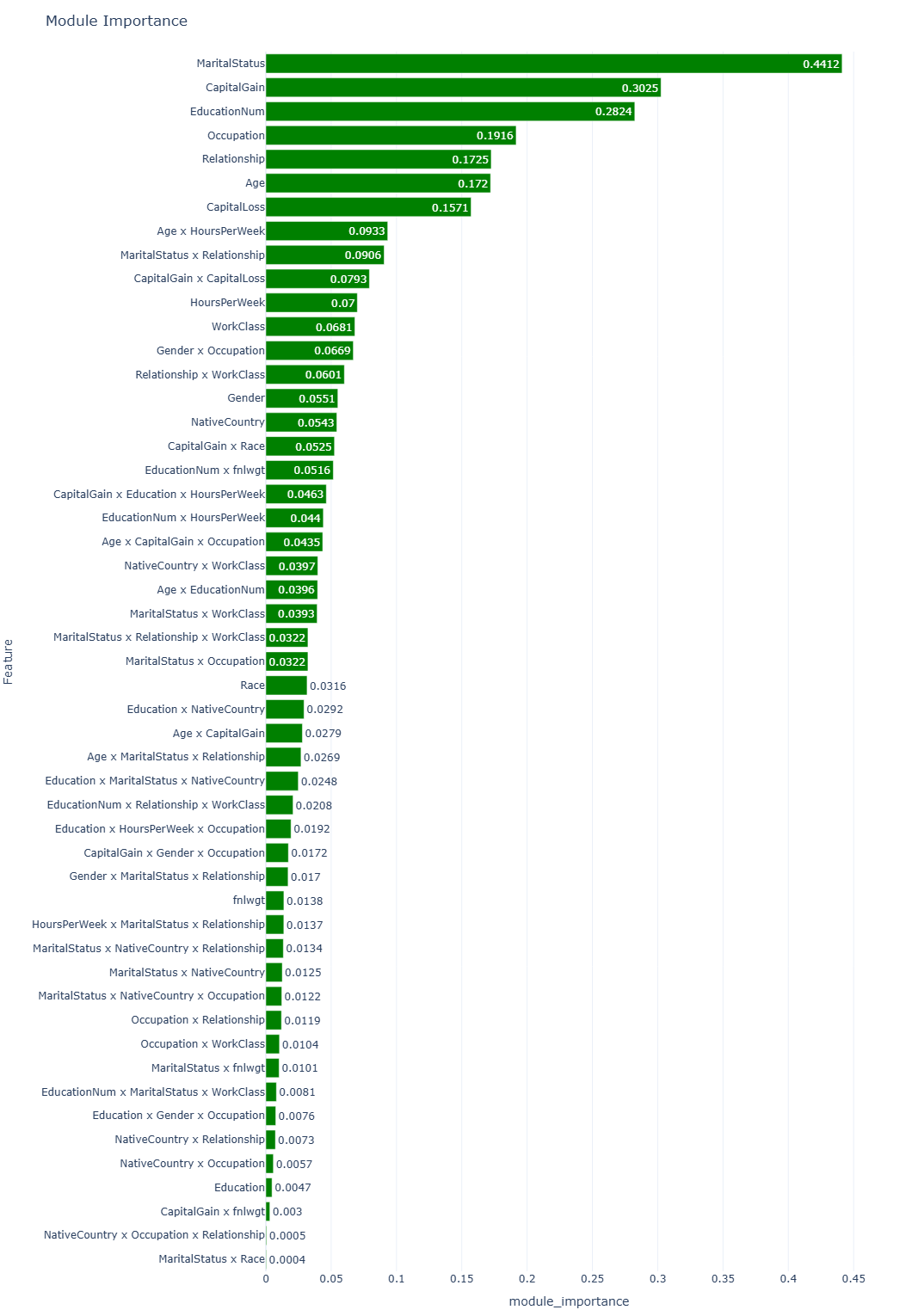
Module importance ranks XNN modules by their global contribution.
An XNN is composed of modules. Each module represents either a feature or a feature interaction. Module importance uses module attributions to show which modules have the largest impact, on average, across the whole dataset or a selected segment.
This helps answer questions such as:
The calculation uses the mean of the absolute value of module attributions across the dataset or segment of interest.
The sign of the attribution is ignored for importance. This means a module can be important whether it usually increases or decreases predictions.
Feature importance
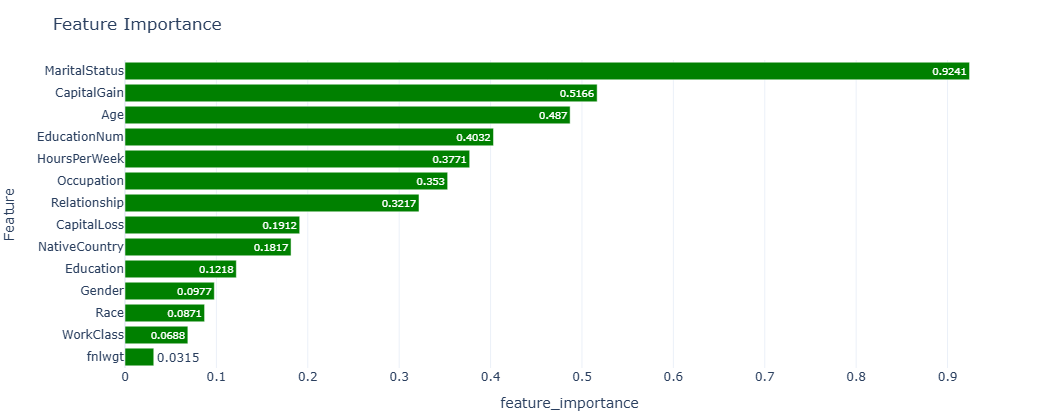
Feature importance ranks individual input features by their global contribution.
A feature can affect a prediction directly through its own module, and indirectly through interactions with other features. To account for both, the calculation uses attribution decompositions, which allocate interaction effects back to the features involved.
The result is a feature-level view of impact across the whole dataset or a selected segment. It shows which input features have the largest average effect on predictions, regardless of whether those effects come from direct feature behaviour, interaction behaviour, or both.
The calculation takes the mean of the absolute value of decomposed module attributions across multiple data rows, then groups those values by feature.
Module importance compared with feature importance
Module importance and feature importance answer related but different questions.
Use module importance when you want to see the model’s structure and the effect of feature interactions.
Use feature importance when you want a feature-level summary that aggregates direct and interaction effects back to individual features.
Segment-level importance
Both module importance and feature importance can be calculated for the whole dataset or for a data segment.
Segment-level importance is useful when the model behaves differently for different groups of data. Comparing importance across segments can show whether a feature, interaction, or module matters more in one region of the data than another.