

Symbolic reasoning
Symbolic reasoning uses explicit representations of knowledge to draw conclusions.
Instead of learning only from patterns in data, symbolic systems work with concepts, rules, relationships, and symbols that represent real-world entities. These symbols can be manipulated according to defined rules, making the reasoning process easier to inspect and explain.
In the platform, symbolic reasoning is part of the neuro-symbolic foundation behind Hybrid Intelligence. It helps make model behaviour more interpretable by connecting learned patterns to structures that humans can inspect, reason about, and use in explanations.
Why symbolic reasoning matters
Symbolic reasoning mirrors important aspects of human cognition.
When people solve problems, they often use abstract concepts, logical rules, and mental models. A symbol can stand for an object, idea, relationship, condition, or action. Reasoning happens by manipulating those symbols according to rules.
This is different from purely neural approaches, where knowledge is primarily represented through learned numerical patterns. Symbolic reasoning uses explicit representations of knowledge, which can support:
This makes symbolic reasoning especially important for neuro-symbolic AI systems, where learned model behaviour is combined with explicit structures such as modules, partitions, rules, bins, and explanation graphs.
Reasoning strategies
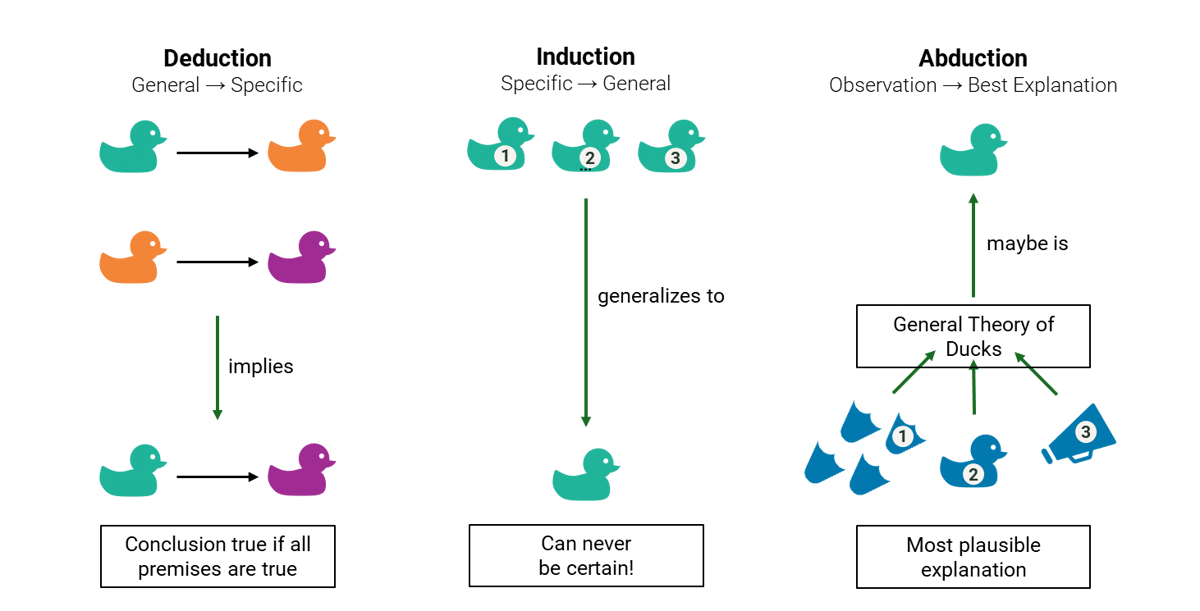
Symbolic reasoning commonly uses three strategies: deduction, induction, and abduction.
Deduction
Deduction applies general rules to specific cases.
It moves from general premises to specific conclusions. If the premises are true and the reasoning is valid, the conclusion follows with certainty.
For example:
Any untested code may contain bugs.
This new feature has not been tested.
Therefore, this new feature may contain bugs.
Deduction is useful when rules are known and the goal is to apply them consistently.
Induction
Induction generalises from specific observations to broader patterns or rules.
Unlike deduction, inductive conclusions are probable rather than certain. They are based on observed patterns and may need to be revised when new evidence appears.
For example, a QA engineer may observe that system performance degrades at certain times of day and infer that high user traffic affects responsiveness.
Induction is central to learning from experience. It helps create mental models, identify patterns, and form expectations from limited observations.
In the platform, Induction also refers to the model discovery, fitting, and training process used to create XNNs from training data. This page uses induction in the broader reasoning sense.
Abduction
Abduction infers the most likely explanation for an observation.
It is especially useful in diagnostic scenarios and hypothesis generation. When several explanations could fit the same observation, abduction helps identify the most plausible one.
For example, a data scientist investigating anomalous model behaviour may consider several possible causes: data quality issues, feature selection problems, distribution shift, or hyperparameter settings. Abductive reasoning helps compare these hypotheses against available evidence.
Abduction is central to troubleshooting, scientific discovery, medical diagnosis, and everyday problem-solving.
Symbolic reasoning in Hybrid Intelligence
Hybrid Intelligence uses symbolic reasoning to make learned model behaviour easier to understand and work with.
In an Explainable Neural Net (XNN), symbolic structures such as rules, bins, modules, partitions, and decompositions help expose how predictions are formed.
In an Explanation Structure Model (ESM), symbolic links and graph structures help organise raw model outputs into richer explanations.
Together, these structures support explanations that are interpretable, trustworthy, and easier for people to inspect.