

Explanation Structure Model (ESM)
Explanation Structure Model (ESM)
An Explanation Structure Model, or ESM, organises the information needed to produce explanations from an Umnai model.
An ESM starts from the predictions and raw explanation data produced by an Explainable Neural Net (XNN), then structures that information so it can be inspected, transformed, filtered, ranked, summarised, or used in further reasoning.
ESMs make the explanation process explicit. They describe how answers, justifications, symbolic links, dataset concepts, rules, bins, decompositions, and activation paths fit together to produce an explanation that can be presented to a user or consumed by another system.
Why ESMs matter
An XNN produces a prediction and the raw explanation data behind it. An ESM provides the structure that turns that raw material into a practical explanation.
Given a set of answers, such as predictions, and a set of justifications, such as the workings and decisions that produced those answers, an ESM specifies what should happen next.
For example, an explanation may need to be:
This makes the chain of reasoning explicit. Another way to think about an ESM is as a plan of action for producing an explanation.
ESMs as hypergraph models
ESMs are hypergraph models that store information about the symbolic links inside an XNN, the symbolic concepts associated with the underlying dataset, and other symbolic knowledge used by the explanation system.
They package XNN outputs into an accessible structure that can include:
When an ESM embeds an XNN, it creates the neuro-symbolic transforms and graph connections needed to enrich the raw explanation data from the XNN. This is what enables Hybrid Intelligence explanations to be produced from the model output.
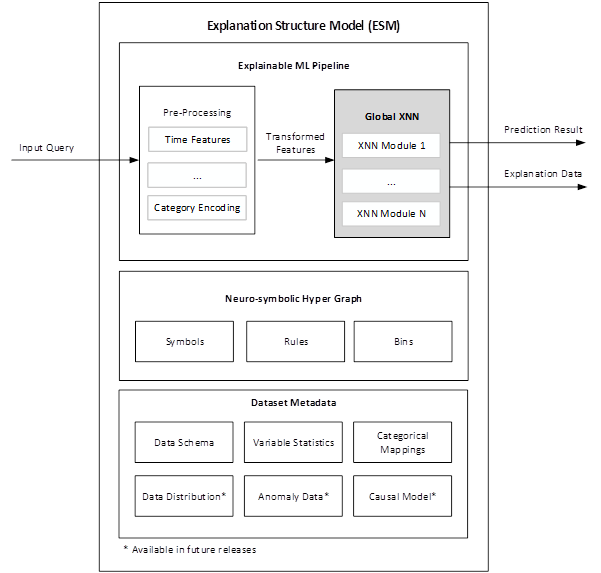
Components
An ESM contains several layers of information and processing.
Together, these components allow the ESM to connect model behaviour, dataset meaning, and explanation structure.
From model output to explanation
ESMs start with information from their embedded XNNs.
An XNN provides specific information about the problem it is solving: predictions, module attributions, feature attributions, activated partitions, rules, bins, and decompositions. The ESM uses that information and applies additional layers of knowledge to make the explanation broader, more structured, and more useful.
These layers can include:
This allows an ESM to move from detailed model behaviour to a higher-level explanation, and from broad explanation structures back down to specific situations when needed.
Multiple models and chaining
ESMs can combine multiple XNNs.
They provide a framework for XNN chaining, multiple-model systems, mixture-of-experts approaches, and multi-agentic systems. This allows explanation structures to span more than one model when the system needs to coordinate several sources of predictive or symbolic information.