

Induction
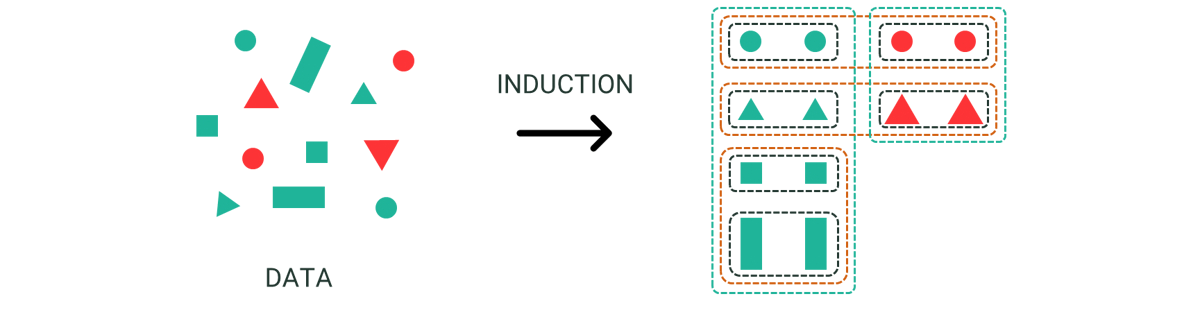
Induction is the model discovery, fitting, and training process used to create the platform models from training data.
During induction, the platform analyses the dataset, discovers feature behaviour and feature interactions, creates model structure, organises that structure into modules and partitions, and trains the resulting model against the configured objectives.
The output of induction is an Explanation Structure Model (ESM) that embeds an Explainable Neural Net (XNN).
Why induction matters
Induction is the process that turns data into an explainable model.
In conventional deep learning, training often focuses on optimising weights inside a fixed or mostly fixed model structure. In the platform, induction also discovers and organises the structure that makes the model explainable: modules, partitions, bins, rules, symbolic links, and the neural substrate of the XNN.
For that reason, induction plays a role similar to gradient descent in deep learning as the core training mechanism, but it is broader: it discovers model structure as well as fitting and optimising the model.
Techniques used during induction
Induction combines several neuro-symbolic techniques.
Together, these techniques allow induction to use statistical, causal, and symbolic knowledge when creating a model.
Induction process
Induction is a multi-step process.
Analyse feature combinations
Induction analyses possible combinations of input features, including interactions between features.
It can also take into account other available sources of information to improve the quality and functionality of the resulting model.
Create modules
Induction creates an initial set of modules.
Each module models the behaviour of a feature or feature interaction. These modules become the main attribution-producing structures inside the XNN.
Create partitions
Induction groups related and similarly behaving regions of input features and feature interactions into partitions within modules.
Partitions structure the behaviour discovered in the data, making the model easier to inspect and explain.
Organise the partition hierarchy
Induction organises partitions into a hierarchy.
The hierarchy establishes relative distances between partitions so that similar partitions are closer together and dissimilar partitions are further apart.
Create bins
Induction splits data into logically related sections called bins.
Bins define feature segments. These segments are used to express the boundaries of partitions and rules.
Create rules
Induction creates symbolic IF-THEN rule representations of the underlying neural model.
The IF part defines when a partition activates. The THEN part defines the local neural model used to calculate attribution. The resulting symbolic model is directly convertible and compatible with the neural substrate of the XNN.
Optimise model structure
Induction optimises the model structure using deep learning, statistical methods, and information theory techniques.
This optimisation refines the structures discovered earlier in the process.
Train and analyse performance
Induction trains the XNN and analyses performance against the training objectives and desired performance metrics.
This ensures that the resulting model conforms to the configured objectives while preserving the explainable structure discovered during induction.
Principles
Induction is guided by a set of basic principles.