

Neuro-symbolic AI and hypergraph models
Neuro-symbolic AI and hypergraph models
Neuro-symbolic AI combines two approaches to artificial intelligence: neural learning and symbolic reasoning.
Neural systems are well suited to learning patterns from data. Symbolic systems are well suited to representing concepts, rules, relationships, and reasoning steps in a form that can be inspected and manipulated.
Umnai’s Hybrid Intelligence framework combines both. It uses learned knowledge from data and symbolic knowledge from human, operational, or domain sources.
Two sources of knowledge
Hybrid Intelligence can draw on two broad sources of knowledge.
Neural networks, such as Explainable Neural Nets (XNNs), are good at recognising patterns in data. Symbolic reasoning explicitly represents and reasons with knowledge.
The combination of these two approaches is known as neuro-symbolic AI or neuro-symbolic machine learning.
How this appears in the platform
In the platform, the neural and symbolic parts of an XNN work together.
The neural part is used for fast pattern matching and numerical computation. The symbolic part is used for reasoning, inspection, and structured explanation. Information can pass between these parts so the model can produce predictions while also exposing the reasoning behind them.
A useful analogy is Daniel Kahneman’s distinction between System 1 and System 2 thinking. The neural part is closer to fast, reflexive pattern recognition. The symbolic part is closer to slower, more deliberate reasoning.
Explainable Neural Nets (XNNs) and Explanation Structure Models (ESMs) provide the model structures needed to make neuro-symbolic AI practical in the platform.
XNNs provide the predictive model and raw explanation data. ESMs organise that information into richer explanation structures. Together, they allow learned information to be inspected, edited, prioritised, and reasoned over.
Graphs and hypergraphs
Graphs are a fundamental data structure for representing objects and the relationships between them.
A graph can represent relationships between individual objects. This makes graphs useful for storing and reasoning about connected information.
A graph network uses this structure as a way to acquire and organise knowledge. It can represent relationships between individual objects and groups of objects, capturing the connections that bind them together.
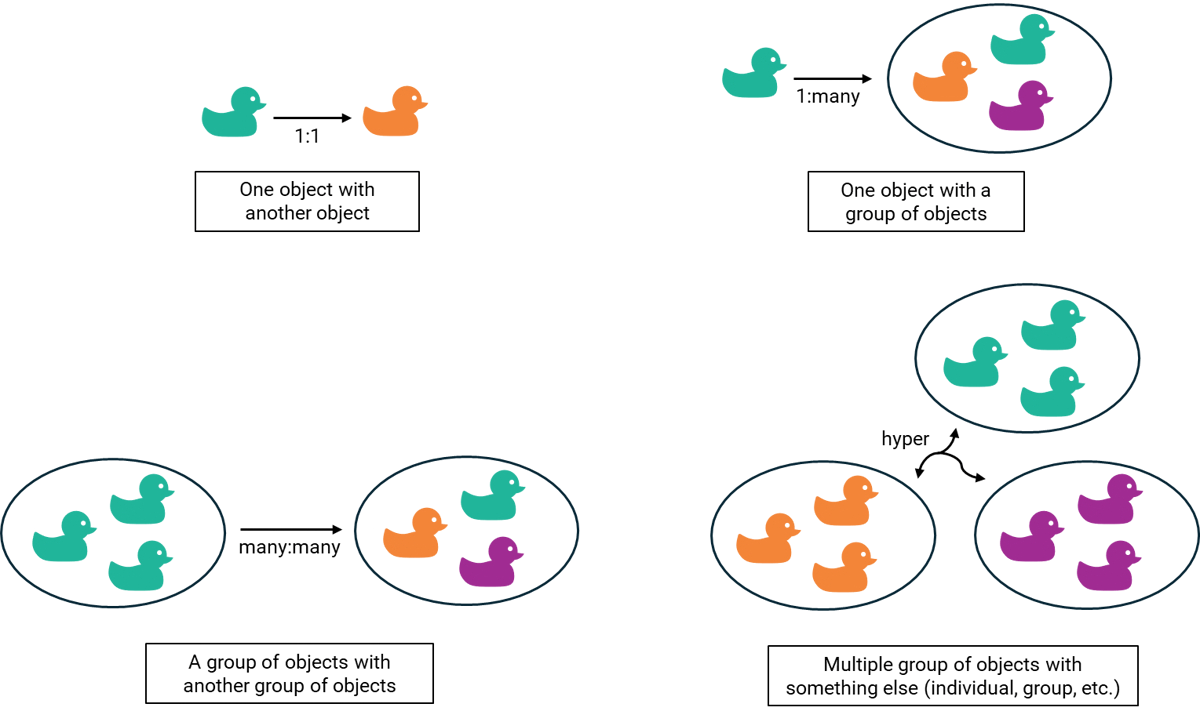
Graphs compared with hypergraphs
Hypergraphs extend graphs by representing relationships between sets of objects, not only relationships between individual objects.
This makes hypergraphs useful for representing more complex and nuanced interactions, especially when the relationship itself involves multiple objects or groups.
XNNs and ESMs as graph structures
Hybrid Intelligence models use graph-based structures.
XNNs are graph models. Their modules, partitions, rules, bins, attributions, and decompositions form an inspectable structure around the model’s predictions.
ESMs are hypergraph models. They can represent richer symbolic relationships across XNN outputs, dataset concepts, rules, bins, activation paths, and other symbolic knowledge.
This is what allows the platform models to combine learned patterns with structured reasoning and explanation.